Technique Lessons
Warm Up
Warming up is an essential step before any show or practice session. Not only does it helps to improve the overall performance of the musician, it also builds confidence and greatly reduces the risk of getting hurt while playing. Here we have a series of exercises that you can use to create your own warmup routine.
Body position & stretching |
String Skipping Pt. I (Right Hand) |
Left Hand Exercises |
String Skipping Pt. II (Right Hand) |
Chromatic Warm Up |
String Skipping Pt. III (Hands' Synchronization) |
Alternate Picking
Using a plectrum or pick to play is one of the most commons way to approach the guitar. The pick is held in the right hand between two fingers, and its tip used to attack the strings on the side of the soundhole. This technique, of course, renders at least two of the right hand fingers unable of playing independently -thus hindering the possibility of complex polyphonic playing. In return, it yields immense benefits in tone control, volume, and speed.
Alternate picking is by far the most used technique in plectrum playing. It involves using a continuous upwards-downwards motion in the picking hand, sometimes even when there are no notes to be played (in order to consistently play upbeats and downbeats with upwards and downwards motions respectively). Tremolo effects become particularly easy to achieve through the use of alternate picking.
Pure downpicking, while useful in certain situations and for certain sounds, is a demanding technique that can quickly become exhausting and difficult to control. It is also rendered impossible by high speed runs, so alternate picking becomes essential for plectrum playing.
Naturally, not every situation can be resolved by employing the alternate picking technique, and sometimes fingerstyle playing, legato playing, sweep picking, or hybrid tapping techniques are a better choice, though alternate picking remains a basic technique, and it should be approached at the beginning of every guitarist's career and perfected on a daily basis.
Legato Playing
The term legato comes from academic classical music, where it is utilized to indicate that two or more notes are to be played or sung as 'connected' as possible, leaving the minimum possible silence between them. Usually the notes that are to be played in this fashion are graphically grouped by a curved line, or slur. Less frequent is the use of the word legato over the staff.
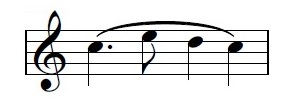
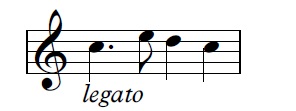
Naturally, this instruction to play 'as connected as possible' has diverse implications according to the technique of each instrument: bowed string instruments, for example, will normally attempt to play slurred groups of notes by employing a single bow movement. Similarly, wind instruments will usually read slurs as instructions to play without using a tongue articulation for each note.
In the field of guitar playing (mostly on popular styles), the term legato is used interchangeably for the actual articulation and a particular technique, which consists of playing a musical phrase using mainly hammer-ons and pull-offs: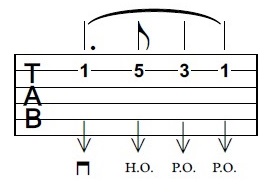
the string is set in motion with the first note played by the pick or the right hand fingers. The following notes are played by means of hammer-ons and pull-offs only. If the musical phrase to be played involves more than one string, the pick may be used to play the first note on each string, activating it and allowing the left hand to play the rest of the notes alone.
The legato technique is an essential tool to develop speed, as it momentarily eliminates the need for strict left-right hand coordination. Sometimes, guitarists will even avoid using the pick or the right hand to set in motion the strings, relying only on their left hand strength. This blurs the line between the legato technique and left-hand tapping (part of the two-hands tapping technique).
From an academic perspective, it should be noted that these are merely the common technical approaches to playing legato, and by no means should the articulation legato be confused with the actual techniques. It is possible to play 'as legato as possible' and still use several bowstrokes, or articulate with the tongue or the pick if it is required (or indicated).
Sweep Picking
Playing single notes on consecutive strings may be difficult when relying only on the alternate picking technique. The permanent direction shifts of the pick, while necessary in most cases, become encumbering in situations such as this:
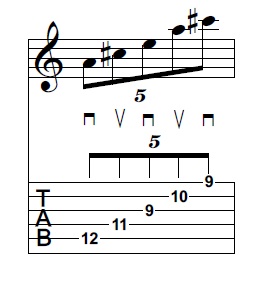
They take a considerable amount of time, making it almost impossible to perform these kind of licks in a fast and clean way.
Sweep picking is a guitar technique that was largely developed in the 1940's, where the guitarist uses a single constant downwards or upwards pick motion to play a series of notes on consecutive strings. This allows a guitar player to perform fast arpeggios or arpeggio-infused licks and melodies, natural to instruments such as the piano, but unpractical for the guitar when relying on traditional picking only.
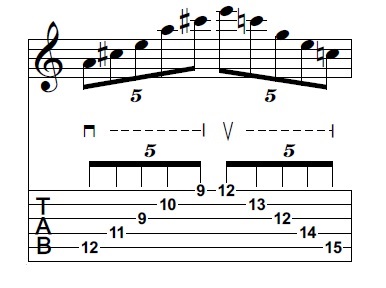
Nowadays sweep picking is a standard item in every guitarist's technique repertoire, with a number of common fretting shapes being basic tools for improvisation. Sweep picking is usually combined with other techniques, both to create interest and to extend the possibilities it offers.
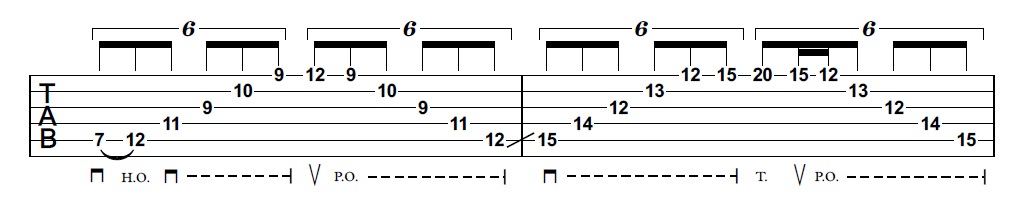
Fingerstyle
The term fingerstyle does not refer to a specific style or genre of music, but rather to a technique that involves playing the guitar by plucking the strings with the fingernails or fingertips, as opposed to doing it with a plectrum or pick. The universe of possibilities that the fingerstyle technique creates makes it look more like a whole different approach to the instrument than a particular technique.
Fingerstyle arguably makes the most of the polyphonic capabilities of the guitar. As strings are struck by individual digits, guitarists are able to play more than one melodic line, and thus cover several textural elements as once.
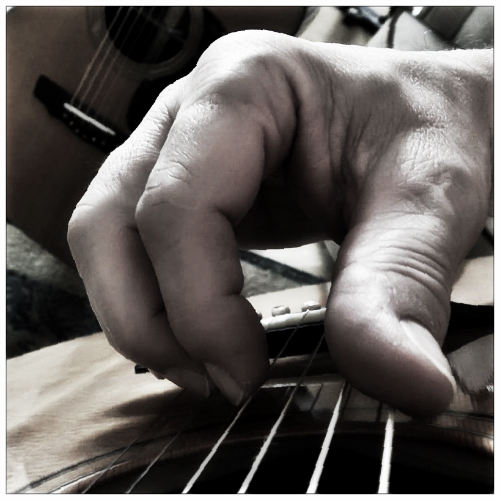
It is possible to extract a great variety of sounds from the fingerstyle technique, depending on factors such as the length and shape of nails, the possibility to use the fingertips instead of nails, the point where the fingers make contact wit the string, the angle at which they make contact, etc. There is also less need to develop a damping technique on the left hand when playing non adjacent strings, as the right hand can avoid the strings in between.The fingers employed individually can attack non-adjacent strings as opposed to the hand used as a single element in traditional picking techniques. Chords become easier to play, whether it be in arpeggiated form (where fingers are a more reliable choice than string skipping) or in block form (up to five strings can be played simultaneously). Complex strumming patterns arise from the individual use of fingers (as in Spanish flamenco).
Conversely, tremolo techniques are much harder to perfect when playing fingerstyle, and it is not as easy to develop speed (starting with the fact that fingers normally attack the strings in a single direction whereas plectrums can alternate directions). Fingernails have to be taken care of, and this usually becomes an enormous issue for fingerstyle playing: they have to be filed, shaped, kept at the right length and thickness. Nylon strings and light gauge steel strings are normally easier to play than heavy gauge strings. Some players compensate for this employing picks that conveniently attach to every finger of the right hand, though, needless to say, these do not yield the same results in terms of tone control.
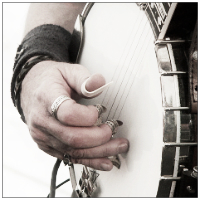
Fingerstyle is the default technique for when approaching the guitar in a classical/academical fashion. In classical guitar tabs are rarely used (except for beginners instruction, or renaissance and medieval music), with traditional notation being the standard. Fingerings are usually given in the score, either by the publisher or the composer. The left (fretting) hand fingers are referred to as 1, 2, 3, and 4 (1 being the index). The right hand fingers are p (thumb), i (index), m (middle), a (ring), and x (or e, little). Naturally, there are certain conventions in guitar fingerings to be studied.
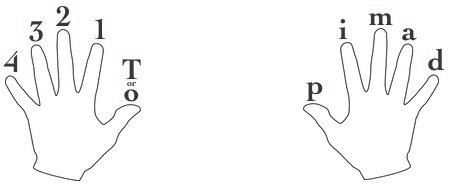
Even though finger playing is the traditional technique in classical music, some non-academical genres tend to see it as an alternative way of playing. It is often seen in acoustic guitar players, and less frequently in electric guitar players (with notable exceptions being Chet Atkins and Jeff Beck, among others). Flamenco guitar is closely related to the classical approach, though it has its own set of techniques. There is a also distinct set of techniques known as fingerpicking, used in certain forms of folk and country music.
Most complete players will have some notions of fingerstyle, even if they regularly incline to play with a plectrum. The possibilities that arise from playing with the fingers take the guitar to a higher level as a soloist instrument. In this line, it is highly recommended that students develop fingerstyle skills.
Tapping
The tapping technique is arguably the most popular of the extended techniques for the guitar. A number of players hailing from different backgrounds perfected variations of the concept throughout the 20th century, though it was definitely brought into the mainstream by Edward Van Halen in the late 70s.
The technique itself consists of fretting the string in the same motion that sets it into vibration. In other words, a single movement is done, 'hammering' the string against the fretboard at a given point, normally with the right hand index or middle fingers. This results in a smooth sounding note, which can be sustained, slided, or more commonly pulled off into any note fretted by the left hand, or an open string. This allows the guitarist to play intervals that would otherwise be impossible to make in a single movement with the left hand only.
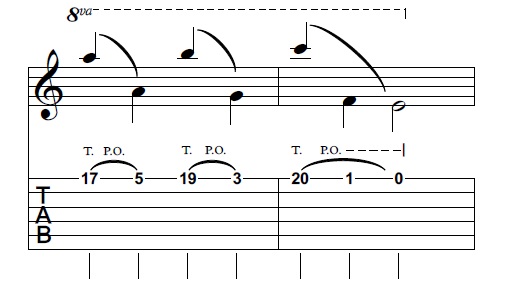
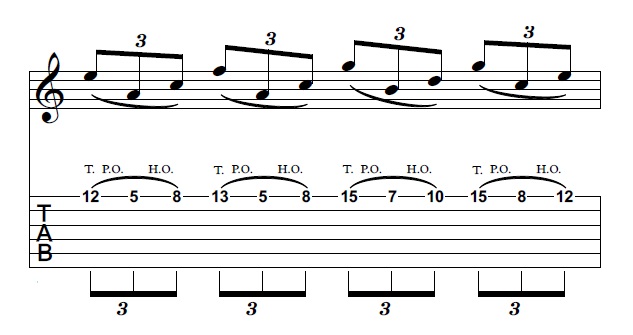
This kind of one handed tapping technique, when combined with left hand pull-offs and hammer-ons, can result in a virtually infinite number of patterns that not only give the player the tools to play passages conceived for other instruments, but also, by doing so, pushes the boundaries of the artistic possibilities within the guitar. One of the most common uses is to play extremely fast arpeggiated chord sequences and variations.
As opposed to one handed tapping, which usually employs one or two fingers from the right hand, two handed tapping often employs eight or nine fingers, making it possible to play complex polyphonic textures on the guitar. Guitarists have experimented with different approaches to this, with Emmet Chapman credited as being one of the firsts to use his right hand fingers parallel to the frets. He later developed his own instrument, now called the Chapman Stick, which is almost exclusively played by using two handed tapping. A number of instruments developed on the same principles exist, though the Stick is arguably the most popular one.
Though mostly used by electric guitar players, tapping can be performed on steel-string and nylon-string acoustic instruments also. Modern amplification paved the way for a number of unconventional techniques to be extensively used in acoustic guitars, with tapping being one of them. When used in the electric guitar, tapping can be performed with high levels of overdrive and compression, in order to boost the tapped notes and even out the volumes of the passages.
Some guitarists choose to tap their guitars with picks or other objects, producing particular effects.
[The header image, originally uploaded to Wikimedia Commons by StickEnterprises, is licensed under the Creative Commons Attribution Sharealike 3.0 Unported License]